Commercial Roofing · Simpsonville, KY
Simpsonville Commercial Roofing Contractor
Protect Large Plant Roofs With Phased Work and Daily Dry-In
Large plant roofs need a Simpsonville commercial roofing contractor that phases the work. We tear off section by section and dry in daily while production continues.
Plant Roofs at Industrial Scale
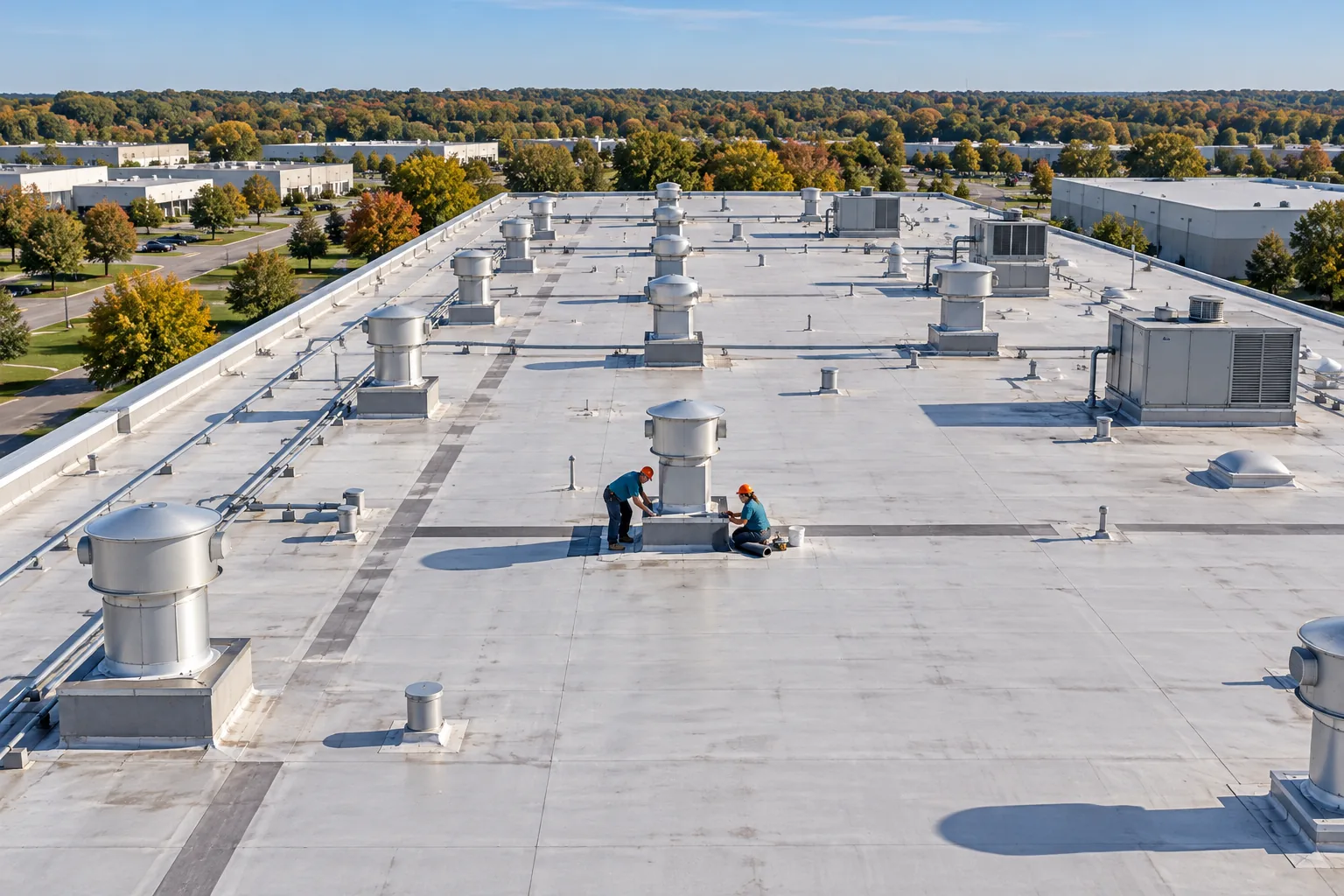
A Simpsonville commercial roofing contractor plans for size first. Kentucky's economic development cabinet announced KCC Manufacturing's 380,000-square-foot Simpsonville plant on Buck Creek Road in 2021, which shows the scale of buildings in the town's industrial areas.
Roofs that size mean phased tear-off, many curbs, and long edge metal runs. Crews work section by section with a daily dry-in, set walkway pads to each rooftop unit, and plan drains and crickets across the whole roof before membrane goes down. The City of Simpsonville building inspector reviews the permit.
- KCC Manufacturing announcement shows the building scale
- Sections opened only as far as the crew closes daily
- Drains and crickets planned across the whole roof
- Walkway pads set to every rooftop unit
What Wears Down Simpsonville Plant Roofs
Big industrial roofs fail where equipment, traffic, and long drainage runs meet the membrane.
Long Runs Between Drains
Wide roofs with drains far apart pond in the middle bays, and the water sits on the membrane for days after each rain.
Service Traffic Wear
Technicians cross the same strip of membrane to every unit, and over time that path wears through the surface without walkway pads.
Residue at Process Exhaust
Process vents and exhaust fans drop dust or residue around their curbs, softening or staining some sheets.
Miles of Edge Metal
Long perimeters carry long edge metal runs, and loose cleats anywhere along them let wind start lifting the roof edge.
Many Curbs to Flash
Plant roofs carry dozens of curbs for fans, units, and vents, and each short flashing is another leak waiting for heavy rain.
Wet Bays Spreading
A slow leak over a big roof can soak insulation across several bays before anyone sees a stain on the plant floor.
Benefits of a New Roof for Simpsonville Buildings
What a planned replacement does for a large Simpsonville plant roof and the operation under it.
Production Keeps Running
Daily dry-in protects stock and lines under each open section overnight.
Water Leaves Every Bay
Crickets and tapered boards move water from the middle bays to the drains.
Defined Service Paths
Walkway pads route technicians to each unit and protect the seams.
Secure Long Perimeters
New cleated edge metal holds the full length of the roof edge.
Commercial Roofing Options for Simpsonville
Large Simpsonville roofs usually call for these three services, often combined across sections.
Industrial Roofing
Phased plant roof replacement planned around production, exhaust, crane days, and dock traffic.
Industrial roofing for plants →TPO Roofing
Mechanically attached TPO over steel deck, a common fit for wide warehouse and distribution roofs with long seam runs.
TPO for large warehouse roofs →EPDM Roofing
Wide rubber sheets for big roof sections with few penetrations, where fewer seams make sense.
EPDM for broad, simple sections →Shutdown or Slow Season Coming Up?
Crane days and curb work fit best into planned downtime. Ask for an inspection now so the phasing plan is ready in time.
Top Commercial Roofing for Simpsonville Plants
How a large Simpsonville roof is replaced while the plant keeps working underneath.
Inspect Your Roof
We map every curb, fan, vent, and drain across the roof, run core cuts in several bays, and flag wet insulation zones before any phasing plan is written.
Phase the Sections
The roof is split into sections the crew can open and close in a day, ordered around production lines, clean areas, and dock activity.
Coordinate the Facility
Air intake shutdowns, crane or hoist days, unit disconnects, and staging clear of dock doors all go on one schedule with the facility team.
Install With Daily Dry-In
Tear-off, tapered insulation, cover board, and membrane go down section by section, each tied to the old roof with a night seal.
Pads, Edges, and Records
Walkway pads go to each unit, edge metal closes the perimeter, and each section's photos and core results go in the roof file.
Find Your Town
Plants, warehouses, offices, and retail buildings in these towns are the roofs we replace. Building outside them? [call us](tel:+18122974110) or [send us a message](/contact).
Jeffersontown
Home base for every town listed here.
Buechel
Metro permits; check the parcel against West Buechel first.
Crestwood
Small retail roofs with several rooftop units to raise.
Douglass Hills
City Engineer letter before the Louisville Metro permit.
Fern Creek
Bardstown Road strip centers with flat roofs and mansards.
Graymoor-Devondale
Parapet roofs and through-wall scuppers on offices and churches.
Highview
Single-drain roofs on small offices, shops, and churches.
Hurstbourne
Office roofs with metal mansards and canopies.
Hurstbourne Acres
Shopping center and office roofs; its own city hall.
La Grange
Oldham County inspections and appearance reviews.
Middletown
Street permits for cranes on tight retail lots.
Mount Washington
Mixed flat and metal roofs along US 31E.
Shelbyville
Steel equipment buildings; city or county inspector by address.
Taylorsville
Metal shops checked by the Spencer County inspector.
West Buechel
Home-rule city rules for contract roofing crews.
Plant Roof Questions for a Simpsonville Commercial Roofing Contractor
Answers on scale, phasing, and access for large industrial roofs in Simpsonville.
Most Asked
What does a large industrial roof replacement in Simpsonville involve?
Phased tear-off, many curbs, and long edge metal runs, on buildings the size of KCC Manufacturing's 380,000-square-foot plant announced in 2021. Crews work section by section with daily dry-in, set walkway pads to each unit, and plan drains across the whole roof. The city building inspector reviews the permit.
How long does a large industrial roof replacement in Simpsonville run?
A large industrial roof replacement in Simpsonville runs as long as its sections, curbs, and weather allow, so the phasing plan sets the length. Each day closes its own section, and curb raises and crane days are scheduled with the facility team.
How does a phased tear-off on a plant roof work?
A phased tear-off on a plant roof opens only the deck the crew can close before evening. Insulation, cover board, and membrane follow before evening, and a night seal ties the new section to the old roof so the floor below stays dry.
Why add walkway pads to rooftop units?
Walkway pads to rooftop units protect the membrane along the paths technicians use most. On a large roof with many units, those paths add up to long strips of wear, and pads installed during replacement cost less than adding them later.
Who inspects the permit inside Simpsonville city limits?
Inside city limits, the City of Simpsonville building inspector reviews the permit. We confirm the parcel and the inspector before the roof plan, with drains, curbs, and edge metal runs marked, goes in.
Can steel deck be replaced while the plant runs?
It can, but deck replacement is planned on its own, because it opens the building to the space below. Core cuts and the tear-off show which bays need it, and those bays are scheduled around the equipment and stock underneath.
Bring In a Simpsonville Commercial Roofing Contractor to Phase Your Plant Roof
Tell us the roof size and what runs beneath it. We will build the phasing plan around both.